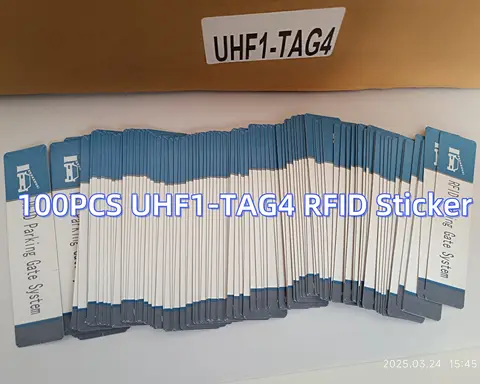
What Are UHF RFID Tags and How Do They Work?
If you're new to RFID technology, you might be wondering: What exactly are
UHF RFID tags and how do they function? The short answer is that
UHF RFID tags are wireless devices that operate in the ultra-high frequency (UHF) range, typically between 860 MHz and 960 MHz. These tags communicate with a
UHF RFID reader to transmit data wirelessly, making them ideal for tracking and inventory management.
- UHF RFID Tag
- A wireless device that uses ultra-high frequency radio waves to communicate with a reader. It can be either passive or active, depending on whether it has its own power source.
- UHF RFID Reader
- A device that sends and receives signals to and from UHF RFID tags. It decodes the data stored on the tag and sends it to a computer or database.
UHF RFID tags are widely used in logistics, retail, and asset tracking due to their long read range and fast data transfer. Unlike HF RFID tags, which operate at 13.56 MHz and have a shorter read range, UHF tags can be read from several meters away, making them more efficient for large-scale operations.
How to Choose the Right UHF RFID Tag for Your Business?
If you're looking to implement UHF RFID tags in your business, you might ask: How do I choose the right UHF RFID tag for my needs? The answer depends on your specific use case, environment, and budget. To help you make an informed decision, here’s a step-by-step guide:
- Identify your use case: Determine whether you need tags for inventory tracking, asset management, or access control.
- Assess the environment: Consider if the tags will be used in harsh conditions, on metal surfaces, or in outdoor settings.
- Choose the right type: Decide between passive UHF RFID tags, which are powered by the reader, or active UHF RFID tags, which have their own battery and offer longer read ranges.
- Check compatibility: Ensure the tags are compatible with your existing UHF RFID reader or UHF RFID scanner and tag system.
- Review specifications: Look at the read range, frequency, memory size, and durability of the tags.
Here’s a comparison of common UHF RFID tags:
| Tag Type | Read Range | Power Source | Best For |
| Passive UHF RFID Tag | Up to 15 meters | Powered by reader | Inventory tracking, retail |
| Active UHF RFID Tag | Up to 100 meters | Battery-powered | Asset tracking, logistics |
| Mini UHF RFID Tag | Up to 10 meters | Passive | Small items, clothing |
| Metal UHF RFID Tag | Up to 12 meters | Passive | Tags on metal surfaces |
What Are the Real-World Applications of UHF RFID Tags?
If you're curious about how UHF RFID tags are used in real-world scenarios, the answer is that they are incredibly versatile. From
UHF RFID ear tags in livestock management to UHF RFID tags in warehouse inventory systems, these devices are transforming how businesses operate. In one case, a logistics company used UHF RFID tags to track shipments in real time. By attaching UHF RFID tags to each pallet, they were able to reduce inventory errors by 40% and improve delivery times. The tags were read automatically at each checkpoint using an
UHF RFID scanner and tag system, eliminating the need for manual scanning. Another example is in retail, where UHF RFID tags are used for anti-theft and inventory management. A clothing store implemented UHF RFID tags on all items, allowing staff to quickly check stock levels and locate misplaced items. The system also helped reduce shrinkage by triggering alarms when tagged items were removed without authorization.
User Reviews and Ratings of UHF RFID Tags
If you're considering purchasing UHF RFID tags, you might ask: What do users say about UHF RFID tags? Based on real user feedback, the UHF RFID tags from leading brands like Impinj and Alien Technology are highly rated for their durability, read range, and compatibility with various UHF RFID readers. Users often praise the
UHF Gen2 RFID tags for their reliability and performance in high-volume environments. One user noted that the UHF RFID tags they purchased were able to withstand extreme temperatures and humidity, making them ideal for outdoor use. However, some users have reported issues with UHF RFID tags that are not properly calibrated with their UHF RFID scanner and tag systems. It’s important to ensure that the tags you choose are compatible with your existing infrastructure.
Other Products and Technologies Related to UHF RFID Tags
If you're interested in UHF RFID tags, you might also want to explore related products such as
UHF RFID tag readers, UHF RFID scanners, and
UHF RFID ear tags. These products work together to create a complete RFID system. For instance,
UHF RFID tag readers are essential for reading the data stored on the tags. They come in various forms, including handheld and fixed readers. UHF RFID scanners and tags are often used in retail and logistics for fast and accurate tracking. Additionally, UHF RFID tags can be embedded with
UHF RFID tag chips that store unique identifiers and other data. These chips are crucial for ensuring the security and accuracy of the RFID system. If you're looking for a more specialized application, consider UHF RFID tags designed for use on metal surfaces or in harsh environments. These metal UHF RFID tags are engineered to maintain performance even in challenging conditions. In summary, UHF RFID tags are a powerful tool for modern businesses. Whether you're tracking inventory, managing assets, or securing your premises, the right UHF RFID tags can make a significant difference in efficiency and accuracy.